 15
15Worldwide
October 20, 2025(Updated: October 20, 2025)
When the Trade War Targets the Silver Screen: Trump’s “100% Movie Tariff” Threat and Why It Could Hit Britain the Hardest

On September 29, 2025, U.S. President Donald Trump once again vowed to impose a 100% import tariff on all movies produced outside the United States a clear protectionist move meant to “bring filmmaking jobs back to America.”
However, for the global film industry and especially for Britain’s thriving production ecosystem this threat is far more than a political headline. If implemented, it could deliver a serious blow to one of the UK’s few booming creative sectors, one that thrives on international investment and Hollywood partnerships.
This article examines Trump’s proposal, why the UK is particularly vulnerable, potential impact scenarios, and how Britain’s film industry can prepare to adapt.
The Policy: What Exactly Is the “100% Movie Tariff”?
In May 2025, Trump first declared on social media that he would “impose a 100% tariff on all movies made outside the United States,” claiming that “our movie industry has been stolen by other countries.”
By late September, he doubled down on the promise: “We will impose a 100% import tariff on foreign-made films.”
The problem? No one yet knows how such a rule could even be defined or enforced in today’s globalized film industry.
According to Reuters, the global film community is “not panicking just yet”, seeing the threat as politically charged but legally murky.
Why the UK Could Suffer the Most
A Production Hub Built on Global Investment
The United Kingdom has become one of the world’s premier hubs for film and high-end television (HETV) production.
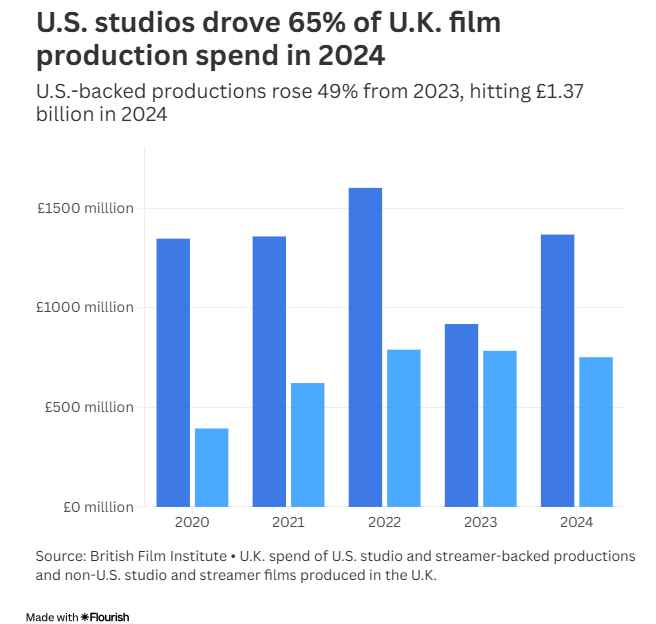
In 2024, total film and HETV production spending in the UK reached £5.6 billion, with £4.8 billion coming from foreign investment, mostly American studios.
The UK’s highly competitive film, TV, and VFX tax reliefs make it a magnet for Hollywood: up to 34% for film/HETV production and 39% for VFX since April 2025, with no 80% cost cap.
As a result, dozens of major U.S.-funded projects are shot, edited, or finished in Britain, supporting tens of thousands of jobs and billions in revenue.
Dependence on the U.S. Market and Globalized Models
Hollywood studios increasingly film abroad to cut costs or use foreign incentives. If the U.S. suddenly imposes a 100% import tax on films made abroad, that model collapses.
For the UK, where many “American” films are actually shot on British soil, this could mean losing a key source of work and investment.
The Investor Chill Factor
Reports from Sky News describe how Trump’s tariff talk has already caused uncertainty: some studio owners in London noted that “big productions that had been inquiring suddenly went quiet.”
Even without concrete policy, uncertainty alone is enough to make investors hesitate on long-term studio deals a dangerous pause for a sector that thrives on stability.
Three Scenarios for Britain’s Film Industry
Scenario A – Pure Rhetoric (No Real Implementation)
If the “100% tariff” remains mere campaign rhetoric, the immediate impact will be limited.
The UK’s robust tax incentives, advanced infrastructure, and skilled workforce would continue to attract Hollywood projects. Many studios — Disney, Amazon, Netflix — have already locked in decade-long leases at Pinewood and Shepperton.
Scenario B – Partial or Targeted Enforcement
If the tariff applies only to certain types of productions (e.g., fully shot abroad), studios will likely restructure projects to qualify as “partly American.”
Under this case, the UK might lose some large-scale shoots but still retain VFX and post-production work, thanks to its unmatched expertise and generous tax credits.
However, new investment may slow as studios wait for clearer guidance.
Scenario C – Full 100% Tariff Enforced
Should the U.S. actually impose a blanket 100% import tax on all foreign-made films:
Production costs would skyrocket for Hollywood studios shooting abroad.
Many projects could relocate back to U.S. soil, cutting the UK out of lucrative work.
Thousands of jobs across Britain’s film ecosystem — from set builders to logistics to hospitality — would be at risk.
Investment would likely divert to lower-risk regions or nations with compensating trade agreements.
Still, industry experts argue that a globalized production chain is nearly impossible to tax cleanly. Many films are multinational efforts — shot in one country, edited in another, and distributed globally. Legal and trade barriers would make enforcement “almost impossible.”
How Britain Can Respond
• Strengthen Policy Coordination and Diplomacy
The UK government should open formal talks with U.S. counterparts to clarify the scope of the threat and lobby against any broad-based enforcement. In May 2025, British officials already held preliminary discussions with U.S. trade representatives — this should continue proactively.
• Enhance Domestic Incentives
Maintaining — or even expanding — existing film and VFX tax reliefs will be vital to keeping Britain attractive, even amid uncertainty.
The government should also invest in talent development, ensuring that British crews and studios remain indispensable partners for global productions.
• Diversify Partners and Markets
Overreliance on the U.S. makes the UK vulnerable. Collaborations with India, East Asia, and Europe can balance risk while expanding the UK’s creative influence.
Bollywood, for instance, is increasingly using UK studios for big-budget projects — a trend Britain could build upon.
• Integrate Risk Clauses into Contracts
Studios and production houses should include “tariff-trigger” or “political-risk” clauses in their contracts with foreign investors, ensuring flexibility if U.S. policy suddenly shifts.
They should also develop fallback plans — for example, pivoting to streaming series or international co-productions if large U.S. projects pull back.
A Serious Threat — But Not Yet a Death Sentence
Trump’s 100% movie-tariff proposal may never fully materialize, but its ripple effects are already being felt.
Britain’s film sector remains strong — backed by world-class infrastructure, a skilled workforce, and one of the most competitive tax regimes in entertainment.
Yet, the uncertainty itself is damaging: investors dislike unpredictability, and hesitation today could mean lost opportunities tomorrow.
If the UK government and creative industry act decisively — reinforcing stability, courting new partners, and defending open tradethey can turn this threat into a strategic reset that secures Britain’s place as a global filmmaking powerhouse.
Source: CNBC