 15
15Worldwide
October 25, 2025
When the Inflation Pot Cools Down: America Breathes Easier as the Fed Prepares to Cut Rates

After months of inflation “burning through wallets,” the U.S. finally has a reason to exhale prices rose less than expected. The September CPI report, released by the Bureau of Labor Statistics (BLS) on Friday, showed that inflation is easing, offering a glimmer of hope that the Federal Reserve may soon begin cutting interest rates at its upcoming meeting.
“Numbers That Speak” – When CPI Made Wall Street Smile
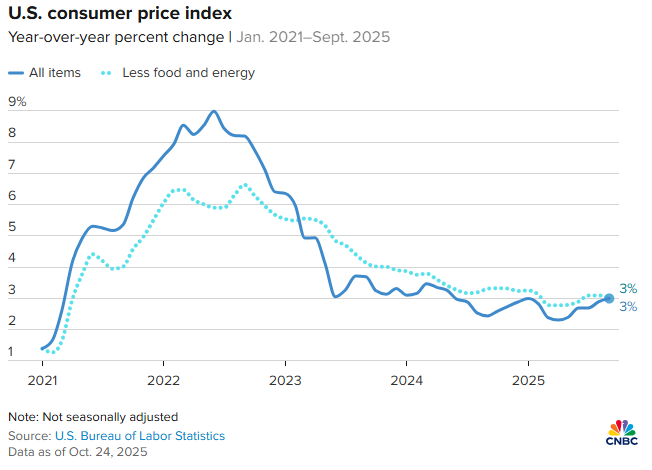
The Consumer Price Index (CPI) rose 0.3% in September and 3.0% from a year ago — both slightly below Dow Jones’ forecasts of 0.4% and 3.1%.
Core CPI, which excludes volatile food and energy components, increased 0.2% month-on-month and 3.0% year-on-year — signaling that underlying price pressures are continuing to ease.
John Kerschner, Global Head of Securitized Products at Janus Henderson, put it colorfully:
“This CPI report feels like an oasis in the desert — finally quenching investors’ thirst for data during a government shutdown.”
Immediately after the release, U.S. stock futures ticked higher, while Treasury yields slipped, reflecting rising bets that the Fed will move to ease policy soon.
“Gas Prices Dance Again — But Inflation Doesn’t Panic”
Gasoline prices climbed 4.1% during the month — the single biggest upward driver in the CPI basket. Yet this was offset by relative calm in other sectors:
Food prices rose only 0.2% on the month and 3.1% over the year.
Energy prices gained 2.8% year-on-year, with electricity up 5.1% and natural gas up 11.7%, though gasoline actually fell 0.5% from a year earlier.
Overall goods prices advanced just 0.5%.
Housing costs — roughly one-third of the CPI weighting — increased only 0.2% in September, much slower than earlier this year, helping to pull headline inflation lower.
David Russell, Global Market Strategist at TradeStation, summed it up:
“Inflation may not be cooling rapidly, but at least it’s no longer surprising anyone on the upside.”
“The American Wallet” Still Feels the Squeeze
Looking closer, inflation continues to hide in the everyday essentials:
Prices for meat, poultry, fish, and eggs surged 5.2% year-on-year.
Non-alcoholic beverages rose 5.3%.
Shelter costs remain up 3.6% — still the heaviest burden for most households.
Other service categories excluding housing also ticked up 0.2%, showing that rents, healthcare, and education remain sticky.
On a brighter note, used-car prices dropped 0.4%, providing some relief for consumers making large purchases.
“The Fed’s Next Move” – Is a Rate Cut Around the Corner?
With inflation easing more than expected, investors are now nearly certain the Fed will cut rates at the upcoming Federal Open Market Committee (FOMC) meeting.
The benchmark federal funds rate currently stands at 4%–4.25%, and markets are pricing in a likely 0.25-point cut, with another possible move in December.
Art Hogan, Chief Market Strategist at B. Riley Wealth, commented:
“This report reinforces the Fed’s confidence in its easing path. Policymakers are focusing on a weakening labor market and will continue to prioritize full employment, even if core CPI remains above the 2% target.”
In short, the Fed appears increasingly inclined to support growth rather than over-tighten in pursuit of perfect inflation control.
“Trump Tariffs” – The Unlit Fuse
Interestingly, the tariffs imposed by President Donald Trump have so far had only limited impact on overall prices.
James Knightley, Chief International Economist at ING, noted:
“U.S. companies have cleverly pivoted toward suppliers in lower-tariff countries, softening the initial blow.”
According to Knightley, the effective “real” tariff impact is about 10%, not yet enough to trigger persistent inflation. Still, if the tariff scope widens further, core goods prices could face stronger headwinds in late 2025 and early 2026.
“The Last Data Before the Decision” – CPI, the Fed, and a Nation Holding Its Breath
This CPI release is the final major data point the Fed will receive before its next rate decision. With the federal government partially shut down since October 1, most other reports — jobs, spending, manufacturing — have been suspended.
The BLS was instructed to proceed with the CPI release because the Social Security Administration (SSA) uses it to calculate cost-of-living adjustments (COLA) for millions of beneficiaries.
That makes the September CPI the temporary compass guiding monetary policy and market sentiment until Washington’s budget gridlock is resolved.
“A Sigh of Relief, But Don’t Fall Asleep”
September’s softer inflation numbers are encouraging — but this isn’t victory yet. At 3.0%, inflation remains above the Fed’s 2% goal, and stubbornly high costs in energy, food, and housing continue to cloud the picture.
Rate cuts may be coming, but they will likely be measured and cautious, given lingering uncertainties:
The delayed impact of new tariffs;
Weakness in hiring and household spending;
And political risks that could rattle markets without warning.
A Gentle Breeze, Not Yet Springtime
September 2025 marks a turning point — the U.S. seems to be edging out of its inflation-heavy phase, but the journey to the Fed’s 2% target remains long.
The good news: the Fed now has room to ease policy, giving the economy and markets some breathing space.
The bad news: inflation isn’t gone — it’s just taking a nap.
For investors, consumers, and policymakers alike, this is a moment of “cautious optimism.” A small gust — from fuel prices or tariffs — could easily tip the delicate balance of the economy in the weeks ahead.
Source: CNBC