 15
15News
February 6, 2026
Silver’s One-Month Volatility Tops 100%: Where Is the Bottom and What Should Investors Watch?
.jpeg&w=3840&q=75)
This week, silver has become the standout in the precious-metals space not because of a steady trend, but because of extreme, whipsaw volatility. The rapid drop, sharp rebounds, and erratic price action have pushed one question to the top of every trading desk:
Where is the bottom and when?
Rather than treating this as a simple “guess the low” game, the market is increasingly framing it as a re-pricing phase driven by de-risking, leverage unwinds, and speculative flows.
What just happened? (Key numbers worth noting)
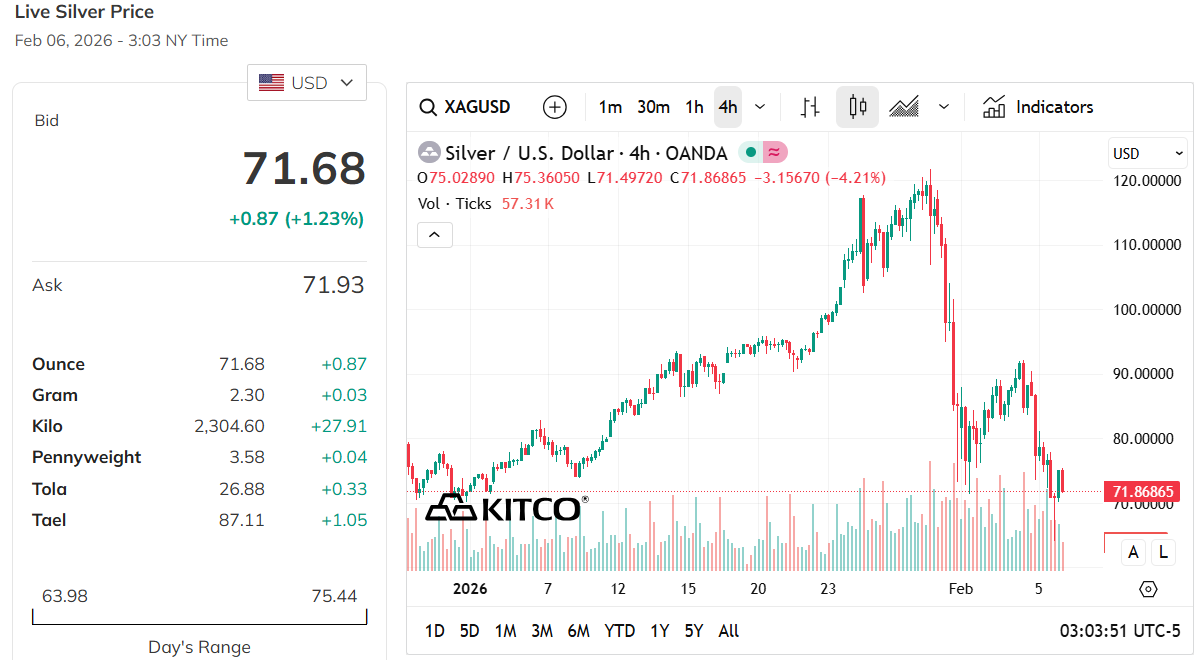
In one of the week’s most volatile sessions, spot silver fell about ~10%, then clawed back losses and was up more than 2% near $73/oz (around 11:30 p.m. ET in the timeline you referenced).
On the futures side (New York), prices were cited around $72.34/oz after a sharp intraday drop.
Reuters also described classic “range-tearing” behavior: silver briefly dipped below $65/oz during the session before rebounding to around the $73–$74/oz area showing how aggressively liquidity and positioning are shifting under stress.
Another structural sign of stress: CME raised margin requirements for silver, with COMEX 5000 Silver Futures margin reportedly lifted to 18% from 15% (effective after the Feb 6 market close). When margins rise during volatility spikes, markets often see additional forced position reductions, especially among leveraged participants.
Why is silver behaving “wilder” than gold?
UBS strategists have pointed out that the recent sharp decline appears to be driven more by broad risk-off sentiment than by a sudden collapse in long-term fundamentals but they also warn that extreme volatility makes short-term exposure unusually risky.
A key point from UBS is the volatility regime shift:
1-month historical volatility has surged beyond 100% (UBS cited levels around ~115% in recent commentary), while 3-month volatility has also risen sharply (around ~78% in the same context).
UBS further notes that for silver to hold above ~$85/oz, the market likely needs sustained investment demand—without that, elevated price levels can be difficult to defend.
Meanwhile, additional “microstructure” distortions have appeared:
In China, a silver futures-linked fund was reported to fall repeatedly by daily limits and at times traded at a meaningful premium to NAV, complicating price discovery and amplifying speculation.
Where is the bottom?” Three more realistic ways to think about it
When the market’s one-month volatility pushes into triple digits, asking for a single “precise bottom” is usually a trap. A more practical framework is zones + scenarios:
Short-term psychological/technical zone: around $65/oz
Silver’s sharp intraday dip below $65 and quick rebound suggests this zone is being watched closely and can trigger reactive buying at least temporarily.
A “re-pricing / mean-reversion” zone: around $60/oz
Several strategists have highlighted $60/oz as a level that can make sense under a more conservative fundamental lens especially if risk-off conditions persist and high prices begin to constrain industrial demand.
A return to “euphoria”: above $85/oz requires conditions
The market may struggle to sustain elevated levels above ~$85/oz without durable investment inflows. In other words, it’s not just about price it’s about whether the demand base becomes stable again.
The longer-term story may still be intact but the path will be rough
Despite the near-term damage to sentiment, many analysts still argue that silver has enduring drivers:
macro: lower nominal/real rates, global debt concerns, USD depreciation risk
growth: potential expectations for global economic recovery
fundamentals: the industrial role of silver in solar, electronics, and other technologies
However, silver’s “hybrid” nature is exactly why it gets hit harder during sudden de-risking:
it behaves partly like a precious metal
partly like an industrial metal
and partly like a speculative high-beta instrument
That blend makes silver especially vulnerable when risk appetite collapses abruptly.
What should investors do during extreme volatility? (Risk framework, not a buy/sell call)
If you’re writing this as an investor-education blog, the most valuable part is the risk discipline:
Reduce leverage / control position size: when exchanges raise margin requirements, forced selling risk rises.
Stop hunting for “one perfect bottom”: define zones (e.g., $65 → $60) and tie actions to conditions (risk-off easing vs. worsening).
Use strategies that tolerate noise: if trading short-term, treat volatility as a “cost of entry” set risk limits first, not profit targets first.
Watch the broader tape: when equities/crypto/commodities are all whipping, silver rarely becomes calm in isolation.
Silver is currently in a regime where two common mistakes become expensive: panic selling or overconfidence. With one-month volatility pushing beyond 100%, “calling the exact bottom” becomes less analysis and more roulette.
A better approach is to think in zones, build scenario-based rules, and prioritize risk management because silver may need time to cool off before a sustainable new trend can form.
(This article is for informational and educational purposes only and does not constitute investment advice. Precious metals can move sharply, especially under leverage and risk-off conditions.)
Source: CNBC