 15
15Business
January 24, 2026
Silver Breaks $100/oz, Gold Near $5,000/oz: A Safe-Haven Wave or a Market Getting Too Hot?

On January 23, 2026, the precious-metals market stepped into truly historic territory: spot silver surged to around $100/oz, breaking the three-digit mark, while gold traded near $5,000/oz, only a small move away from the psychological milestone.
On the surface, it’s a clear win for anyone who has stayed committed to the “precious-metals narrative” for the long haul. But behind the celebratory headlines, the market is also sending a blunt message: volatility can be extreme, and calling the top too early or chasing too late can both be costly, especially when leverage is involved.
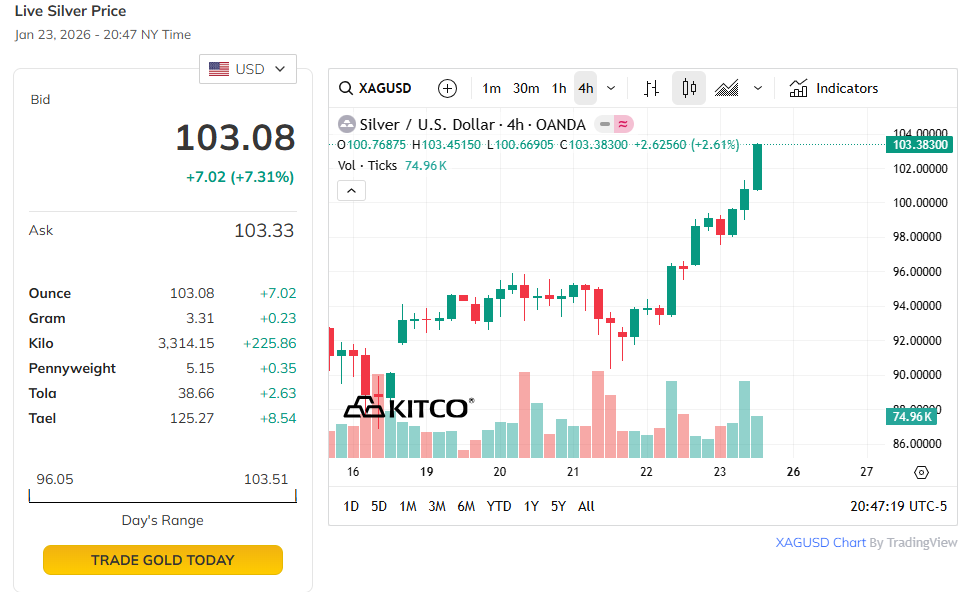
Why did silver explode and why is gold “one step away” from $5,000?
Geopolitical risk returned at the worst possible moment: when sentiment is fragile
Part of the fuel came from renewed geopolitical tension tied to U.S.–Europe friction around Greenland. Hardline statements, tariff threats, and rapid policy reversals pushed markets into defense mode. In that environment, gold and silver typically benefit because they’re viewed as politically neutral assets less dependent on policy promises that can change overnight.
Rate-cut expectations and institutional uncertainty intensified the bid
When markets price in lower interest rates, the opportunity cost of holding gold (a non-yielding asset) declines making it more attractive. Add concerns about policy credibility and institutional stability, and you get the kind of backdrop that keeps safe-haven demand sticky.
Central-bank gold buying remains a powerful structural foundation
Central-bank demand has continued to play the role of “cold, heavy money” not chasing day-to-day headlines, but helping form a durable base under the broader trend.
Why is silver moving even more aggressively than gold?
Silver has two identities:
A precious metal: it rallies with gold when investors seek safety.
An industrial metal: it’s tied to energy, electronics, EV supply chains, and especially solar.
The key point: the silver market is smaller, so when safe-haven flows and speculative capital arrive simultaneously, the move can become exaggerated. Many analysts also point to multi-year supply-demand deficits as an additional tailwind, with industrial demand still playing a major role.
What should investors do in this environment?
There’s no one-size-fits-all answer but there is a framework that helps you avoid the most common mistake: letting emotion override discipline at the worst possible time.
If you’re an investor (safety & long-term allocation first)
Avoid going all-in during peak euphoria. Scale entries over time (DCA) or wait for pullbacks to improve your average cost.
Define the role in your portfolio: Is gold/silver a hedge (insurance), or a growth bet? Different objectives require different sizing and risk rules.
Track the macro “floor”: USD direction, rate expectations, and structural demand (such as central-bank buying).
If you’re a trader (timing & performance first)
Reduce leverage. When volatility rises, yesterday’s leverage becomes tomorrow’s risk.
Enter only with a defined exit plan: stop-loss and take-profit set before you click “buy.”
Favor “buying pullbacks” over “buying headlines.”
Don’t let $100 and $5,000 steal your discipline
Silver above $100/oz and gold near $5,000/oz are major milestones but milestones are not strategies.
At these levels, the advantage doesn’t belong to the most fearless participant. It belongs to the person who:
knows which game they’re playing (investing vs. trading),
maintains risk discipline, and
patiently waits for the market to offer a high-quality entry, not just a thrilling headline.