 15
15Investor
September 9, 2025(Updated: September 9, 2025)
Nikkei Breaks 44,000: How Japan’s Market Reacts After Ishiba’s Resignation

Japan’s Nikkei 225 officially surpassed the 44,000 milestone, highest at 44,208.00 a new historical record for the Japanese stock market. This event occurred only days after Prime Minister Shigeru Ishiba announced his resignation, creating a wave of political turbulence but paradoxically fueling optimism about new policy directions. The rally reflects the close interconnection between economics, politics, and investor psychology, as both domestic and external factors combined to ignite strong market enthusiasm.
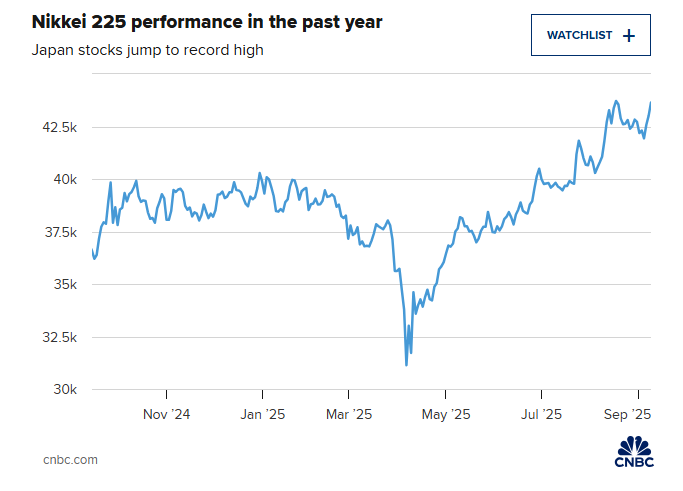
Cre: CNBC
Trade Optimism and Expectations for New Policies
One of the primary drivers behind the Nikkei’s breakout was heightened optimism in international trade, particularly in U.S.–Japan relations. According to a White House announcement, on September 4, U.S. President Donald Trump signed an executive order to reduce tariffs on imported automobiles from Japan, lowering the current rate from 27.5% to 15%. Further details, including the effective date of the new tariff rate, will be announced within seven days. At the same time, Ishiba’s resignation raised expectations that his successor, likely leaders who favor more aggressive public spending, will adopt expansionary fiscal policies and possibly even maintain or expand monetary easing to stimulate growth. In a global environment still marked by uncertainty, Japan’s pivot toward growth through favorable external trade conditions and fiscal flexibility has strengthened investor confidence, both domestically and internationally.
Sector Leaders Driving the Rally
The Nikkei’s record run was not only a matter of index points but also a story of sectoral leadership, showing how capital flows were concentrated in key industries. Advantest, a leading semiconductor equipment maker, surged 6.7%, while chemical producer Tokuyama gained 5%, underscoring the strong appeal of technology and heavy industry. The Topix index, which offers broader market coverage, also advanced 0.4%, confirming that this was not an isolated rally but a wider market trend. Analysts believe that if potential candidates like Sanae Takaichi take leadership, policies favoring public spending and technology sector support will continue to accelerate, providing a long-term growth runway for Japan’s core industries, especially in semiconductors, manufacturing, and energy. This positions the Nikkei as an attractive destination for both domestic and global capital inflows.
Global Context and External Support Factors
Beyond domestic developments, the Nikkei’s surge was also supported by international financial conditions. A weaker-than-expected U.S. jobs report has strengthened the likelihood that the Federal Reserve could soon cut interest rates, boosting global risk appetite and driving funds into equity markets. In a world where interest rates are trending lower, Japan home to the world’s third-largest economy is increasingly seen as a safe yet rewarding investment hub. The convergence of domestic political change, favorable trade developments, and a global easing outlook has created an ideal backdrop for the Nikkei’s rally. Still, risks tied to yen fluctuations and rising bond yields remain potential headwinds that could affect the sustainability of the market’s momentum.
The Nikkei’s move beyond 44,000 points is not only symbolic but also represents a strong vote of confidence from investors that Japan can sustain growth despite political transitions. Beneath this record lies the interplay of trade optimism, international capital inflows, expansionary economic policies, and particularly the leadership role of technology and manufacturing sectors. However, risks stemming from political uncertainty, yen volatility, and rising financing costs highlight that short-term challenges remain. While the Nikkei opens a new chapter of opportunity for investors, closely monitoring political developments and the economic direction of Japan’s next government will be key to making informed investment decision.