 15
15News
June 25, 2026
Gold Falls 28% From Its Peak: A Deep Correction or the End of the Bull Market?

Gold prices are under strong downward pressure as the U.S. dollar rises to its highest level in more than a year and markets increase expectations that the Fed may continue raising interest rates. However, many analysts believe the current correction is not enough to conclude that gold’s long-term uptrend has come to an end.
Gold Slips Below the $4,000 Level
On Wednesday, spot gold fell more than 3%, trading around $3,980.20 per ounce. This is a notable move as the market continues to test the key support zone around $4,000 per ounce.
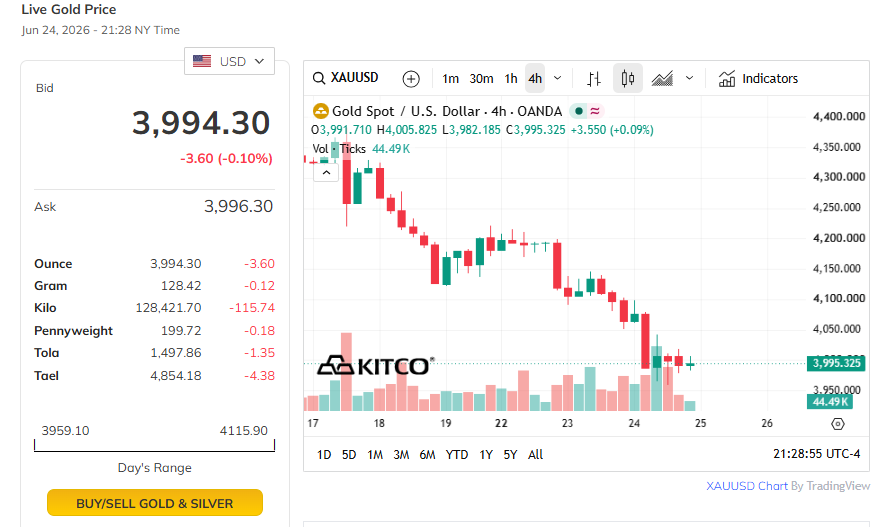
The main pressure comes from the strong recovery in the U.S. dollar. The dollar index has climbed to its highest level in more than a year, making gold less attractive to investors holding other currencies.
Fed Rate-Hike Expectations Continue to Weigh on Gold
Alongside a stronger U.S. dollar, expectations that the Fed may continue raising interest rates are also putting significant pressure on precious metals.
According to the CME FedWatch Tool, markets are pricing in the possibility of a Fed rate hike as early as September, while also not ruling out further tightening in December.
A high-interest-rate environment increases the opportunity cost of holding gold, as gold is a non-yielding asset. This is one of the key reasons why short-term selling pressure has increased.
Is the 28–30% Decline a Major Concern?
Since its January peak, gold has fallen by around 28–30%. This is a sharp correction and may create significant psychological pressure for investors.
However, according to Paul Williams, Managing Director at Solomon Global, the current price action should be viewed within a broader historical context. He noted that deep corrections are not unusual during long-term gold bull markets.
During the 1970s, gold fell by around 45% before surging and reaching new highs in 1980. During the 2008 financial crisis, gold also declined by roughly 30% before recovering and hitting record highs in 2011.
Long-Term Supportive Factors Remain
Although gold is facing short-term pressure, the fundamental factors supporting the metal have not disappeared.
Key drivers such as central bank buying, geopolitical uncertainty, and elevated global sovereign debt levels remain important factors for gold’s long-term outlook.
Notably, even after the current sharp correction, gold is still up nearly 20% over the past 12 months. This suggests that the recent pressure is mainly driven by profit-taking, shifting interest-rate expectations, and U.S. dollar strength, rather than a complete reversal in the long-term trend.
Downside Risks Still Need to Be Monitored
Despite the long-term outlook not being fully invalidated, investors still need to remain cautious about short-term volatility.
Some analysts warn that gold could continue correcting toward the $3,700 per ounce zone if pressure from a stronger U.S. dollar and Fed rate-hike expectations remains in place.
The $4,000 per ounce area therefore remains a key support level to watch in the near term.
Conclusion
Gold is going through a strong correction after a prolonged upward move. A decline of around 28–30% from its peak is significant, but history shows that deep pullbacks do not necessarily mean the long-term bull market is over.
In the short term, a stronger U.S. dollar and expectations of further Fed rate hikes remain the main sources of pressure. However, over the longer term, supportive factors such as geopolitical uncertainty, central bank demand, and elevated sovereign debt levels remain in place.
📌 This content is for market information purposes only and does not constitute a trading recommendation.
Source: Kitco