 15
15Business
October 23, 2025
CRUDE OIL “AWAKENS” – IS A NEW BULL CYCLE BEGINNING?

CRUDE OIL “AWAKENS” – IS A NEW BULL CYCLE BEGINNING?
Oil prices continued to rise on Wednesday, marking their second consecutive session of gains with an increase of nearly 2%. The rally was fueled by optimism over progress in trade negotiations among the U.S., China, and India, as well as Washington’s newly announced sanctions targeting two of Russia’s oil giants in connection with the war in Ukraine.
A strong post-session rally:
Brent crude surged $3.03 (4.94%) to $64.35 per barrel (as of 22:00 GMT).
U.S. WTI crude rose $1.42 (2.43%) to $59.92 per barrel.
Geopolitical and trade tensions continue to dominate the market
Oil prices climbed sharply following reports that the U.S. and India are nearing a new trade deal under which India could gradually reduce its imports of Russian oil—thereby increasing demand for alternative supplies.
President Donald Trump stated that he had spoken with Indian Prime Minister Narendra Modi, who committed to limiting oil imports from Russia.
According to India’s Mint newspaper, Washington is considering cutting import tariffs on Indian goods from 50% to around 15–16%, aiming to strengthen bilateral trade relations.
At the same time, the U.S. and China are expected to meet in Malaysia this week to discuss trade issues. President Trump expressed his desire to reach a “fair deal” with Chinese President Xi Jinping, confirming that the two leaders would hold an “extended meeting” in South Korea next week.
Global supply faces new risks
The energy market also reacted to news that the planned summit between Presidents Trump and Vladimir Putin has been postponed, while Western governments are increasing pressure on Asian nations to cut Russian oil imports.
On Wednesday, the U.S. Treasury Department announced new sanctions on Russian oil giants Lukoil and Rosneft.
“As President Putin continues to refuse to end this senseless war, we are compelled to act.
Lukoil and Rosneft are key financial arteries for the Kremlin’s war machine.”
— Scott Bessent, U.S. Secretary of the Treasury
The new sanctions will limit these companies’ access to international financial markets, raising fears of further disruptions to global oil supply, as Russia remains one of the world’s top three energy exporters.
U.S. energy demand rebounds strongly
Beyond geopolitical tensions, rising energy demand in the U.S. has also provided strong support for oil prices. According to the U.S. Energy Information Administration (EIA), inventories of crude oil, gasoline, and distillates all declined last week—driven by higher refinery runs and strong consumption levels.
Crude oil inventories fell by 961,000 barrels to 422.8 million barrels,
while analysts had expected an increase of 1.2 million barrels.
“Total U.S. oil demand has exceeded 20 million barrels per day—an exceptionally strong figure for a traditionally low-demand period.”
— Phil Flynn, Price Futures Group
Technical outlook: A new upward wave is forming
From a technical perspective, WTI crude has established a short-term bottom around the $56 per barrel area potentially marking the beginning of a new bullish wave.
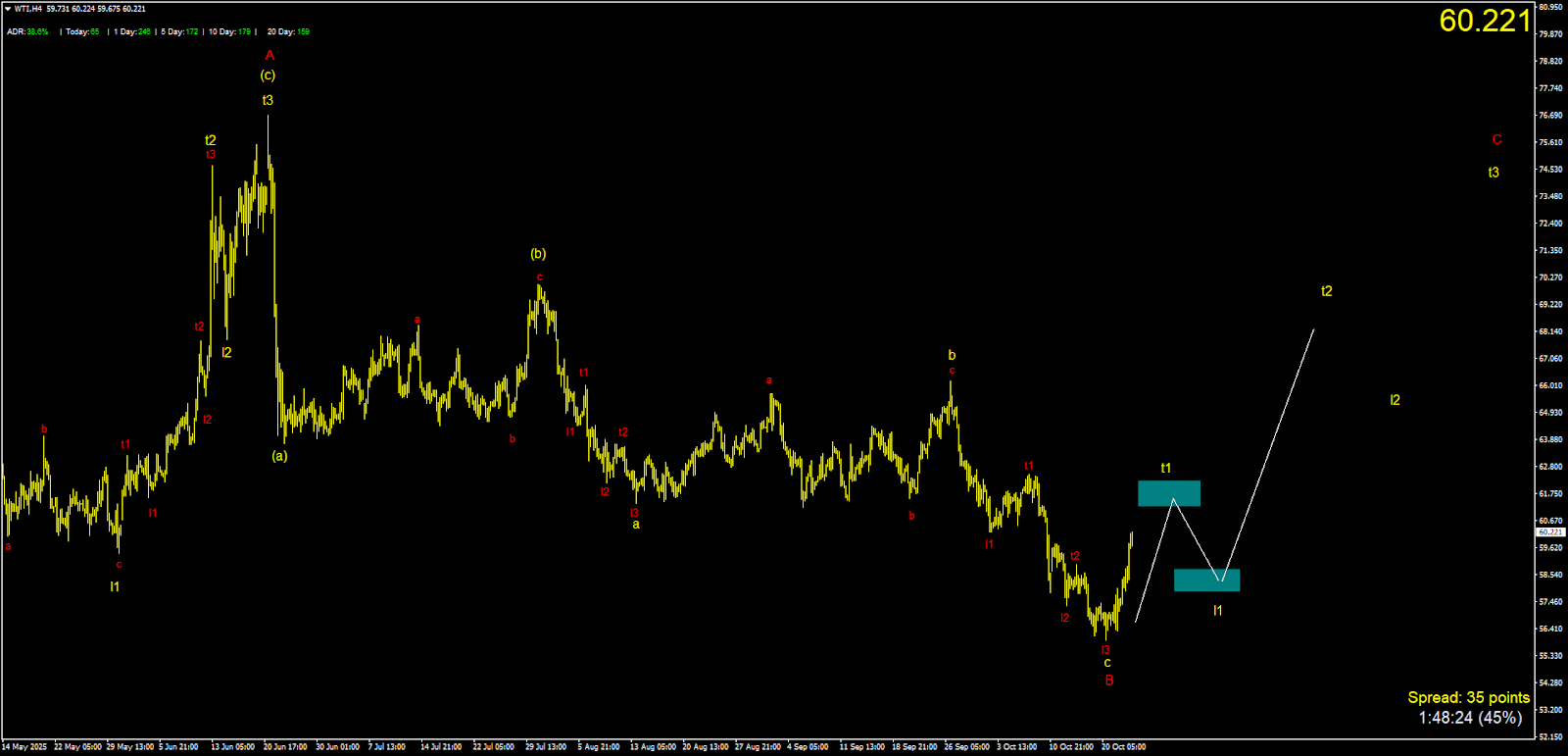
According to wave structure analysis, crude oil prices are currently moving upward from Red Wave B to Red Wave C, with a five-wave impulsive pattern developing within.
At present, Yellow Wave t1 is gradually taking shape.
Following this, a technical correction phase (Yellow Wave l1) is expected to open an ideal buying zone for the next bullish cycle.
Invalidation point:
If oil prices fall below $56 per barrel, this scenario will lose validity, and professional investors should reassess the medium-term outlook.
Positive signals for a new bullish cycle
Combining macroeconomic, geopolitical, and technical factors, the oil market is showing early signs of a new upward cycle:
Geopolitical tensions continue to tighten supply.
Global energy demand remains resilient and elevated.
Technical signals confirm the potential formation of a larger-scale bullish wave.
However, investors are advised to remain patient and wait for the technical correction (Yellow Wave l1) before entering the market to optimize the risk–reward ratio.
If this scenario unfolds as expected, WTI crude could soon target the $64–68 per barrel range in the upcoming bullish cycle.
To stay updated on trading strategies and the latest energy market analysis, follow Ebila AI your trusted source for deep insights, real data, and precise strategic direction for global investors.
If you found this article useful, feel free to share it so more readers can stay informed about key developments in the crude oil market.