 15
15Technical Analysis
September 9, 2025(Updated: September 9, 2025)
Bitcoin Surpasses $113,000: Has the Next “Bull Run” Begun?

Bitcoin Hits a New Record, Driving a Crypto Market Boom
Bitcoin (BTC) – the world’s largest cryptocurrency – has just broken through the $113,000 threshold, sparking a new wave of excitement across global financial markets. Following a series of volatile corrections, Bitcoin is now demonstrating a powerful breakout momentum. The most pressing question for investors is whether this marks the beginning of a historic bull run.
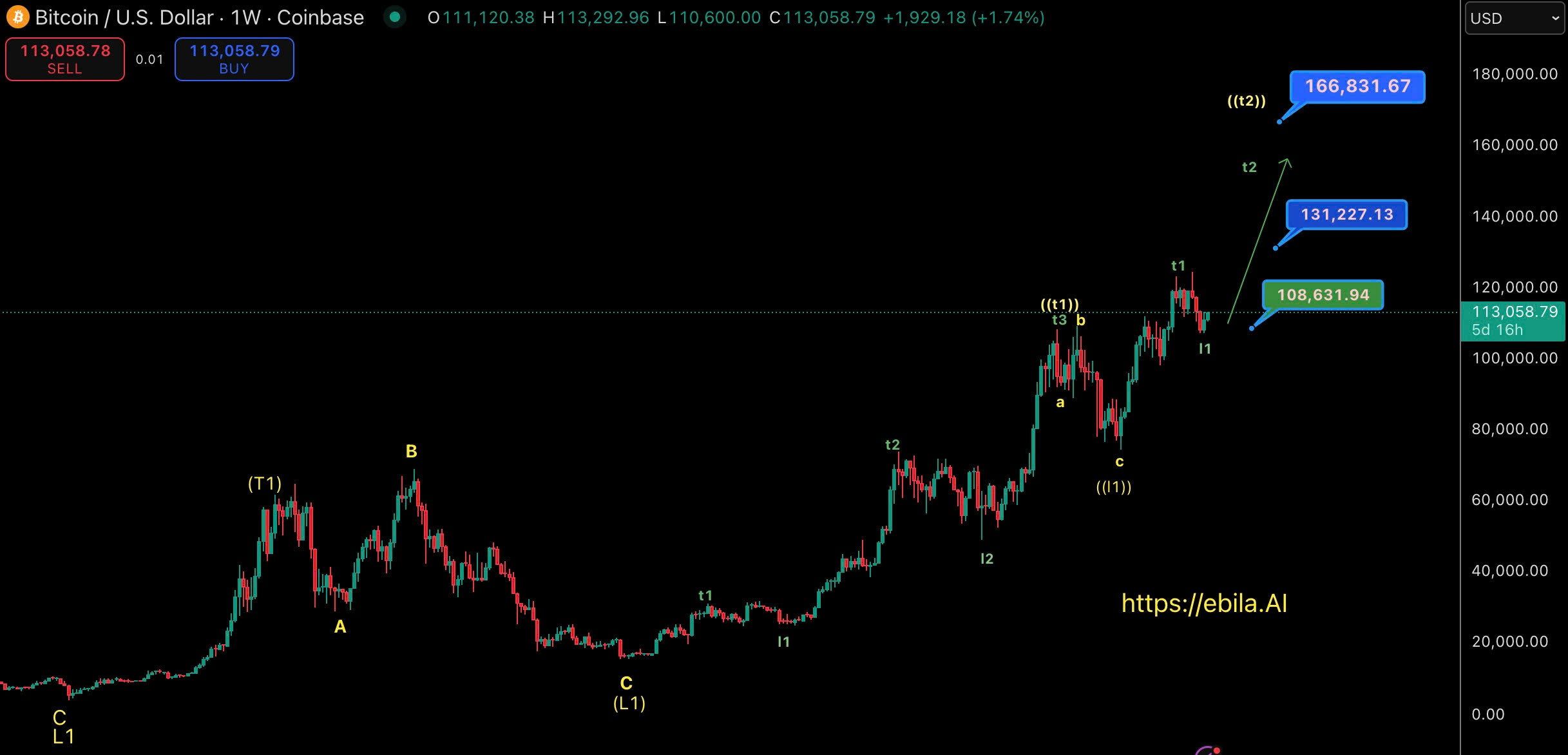
Elliott Waves: A Signal for an Uptrend
According to Elliott Wave Theory, financial markets move in repetitive wave cycles that reflect the collective psychology of investors. In Bitcoin’s current phase, many technical analyses suggest that the price is in Wave 3 – typically considered the strongest and longest wave in an Elliott cycle. Wave 3 usually emerges after the accumulation and breakout stages of Waves 1 and 2, when market sentiment shifts from skepticism to optimism, major capital inflows begin, and the uptrend becomes firmly established. The hallmark of Wave 3 is an explosive increase in both price and trading volume, often accompanied by widespread media coverage and heightened FOMO sentiment among market participants.
Technical data currently indicates that Bitcoin is maintaining a constructive bullish structure, with a key support level around $108,631.994 serving as a critical defense zone. If this level holds, BTC has the potential to continue advancing toward the $131,227.13 range in the medium term, while also opening the prospect for further gains – potentially surpassing the $166,000 threshold in the long term if market momentum persists. This scenario aligns with the dynamics of Wave 3, where prices often exceed expectations due to continuous inflows of new capital into the market.
Key Drivers Behind Bitcoin’s Price Rally
Bitcoin’s growth is not only supported by technical analysis but is also underpinned by several macroeconomic factors:
The 2024–2025 Bitcoin Halving Cycle
The April 2024 Bitcoin Halving was one of the most anticipated events in the cryptocurrency market, as it directly cut in half the amount of new Bitcoin created through mining activity. Specifically, the block reward earned by miners was reduced by 50%, significantly limiting the flow of new BTC into circulation. Historically, each halving has marked a pivotal milestone, often triggering a strong bull cycle for Bitcoin as constrained supply collides with rising demand. This has led many investors to believe that the April 2024 Halving will once again serve as a major catalyst.
Analyst Rekt Capital continues to place confidence in the traditional cycle. He cautions that if Bitcoin follows the 2020 pattern, the market could reach its peak in October 2025 exactly 550 days after the April 2024 Halving.
Federal Reserve Policy
The policy stance of the U.S. Federal Reserve (Fed) has become a central focus for global investors, especially as the U.S. economy shows signs of slowing while inflation continues to ease. Expectations that the Fed may soon cut interest rates have fueled optimism in financial markets, since lower borrowing costs typically encourage investors to shift toward higher-yielding but riskier assets. This has not only supported a robust rebound in U.S. equities but has also helped channel capital inflows into the cryptocurrency market, with leading assets such as Bitcoin, Ethereum, and the broader crypto ecosystem benefiting significantly. Many analysts argue that if the Fed maintains an accommodative monetary stance in 2025, the crypto market could enter a new growth cycle, driven by a favorable policy environment combined with structural catalysts such as Bitcoin halving, ETF approvals, and increasing institutional participation.
Widespread FOMO Sentiment
The spread of Fear of Missing Out (FOMO) is a hallmark of strong bull cycles in the cryptocurrency market. When Bitcoin or other major coins repeatedly reach new highs, the fear of missing opportunities quickly permeates the investor community, particularly among retail traders who are more susceptible to news-driven and short-term trends. They are often drawn to stories of rapid wealth creation and images of outsized profits in a short timeframe, prompting hasty market entry in hopes of “riding the wave.” This surge in buying pressure boosts liquidity, fueling capital inflows into every corner of the market from Bitcoin and Ethereum to altcoins, and even speculative assets such as meme coins. In this environment, bullish momentum tends to sustain itself through a positive feedback loop: rising prices → FOMO → increased inflows → further price appreciation. However, history has shown that FOMO-driven decisions often lack rationality, leading many investors to “buy the top” when markets reverse. Therefore, while acknowledging FOMO’s role in fueling rallies, investors must remain disciplined, avoid psychological traps, and implement sound risk management strategies.
Short- and Long-Term Outlook for Bitcoin
Short-Term (1–3 Months)
In the near term, Bitcoin is likely to continue trading within the $113,000–$131,000 range as it consolidates momentum and builds a stronger price foundation after the recent sharp rally. This is typically a phase where the market experiences strong tug-of-war dynamics between fresh buying interest and profit-taking pressure, resulting in intermittent minor corrections. However, if Bitcoin manages to decisively break out and sustain above the critical $131,000 resistance level, the bullish trend would be significantly reinforced, paving the way for a move toward the $166,000 zone in the medium term. This price range is not only technically significant but also a crucial psychological level, where retail investor euphoria combined with institutional inflows could generate even stronger upward momentum.
Long-Term (2025–2026)
From a long-term perspective, Bitcoin’s outlook becomes even more optimistic, driven by the deepening participation of large financial institutions through Bitcoin Spot ETFs. The approval of such ETFs not only legitimizes Bitcoin in the eyes of traditional investors but also enables massive capital inflows from pension funds, hedge funds, and asset managers to enter the market with greater ease. As demand accelerates while new supply is constrained by the halving effect, scarcity is expected to act as a powerful price driver. Against this backdrop, many analysts and market research institutions argue that the $200,000 level once viewed as unrealistic has now become a feasible scenario. Should macroeconomic conditions prove favorable, such as declining global interest rates, stabilized inflation, and clearer regulatory recognition, Bitcoin could reach historic valuation milestones, further solidifying its position as the “new safe-haven asset” of the 21st century.
Great Opportunities, But Significant Risks
Despite the clear upside potential, the crypto market has long been notorious for sudden and sharp corrections. Periods of heightened FOMO often coincide with the greatest hidden risks. Investors must remain disciplined, apply strict risk management, and avoid letting emotions drive their decisions.
Bitcoin is entering one of the most fascinating chapters in financial history. Yet the critical question remains: is this truly a golden window to hold Bitcoin, or merely a bull trap before the market experiences another shakeout?
To stay updated on Bitcoin’s daily trends, please visit the AI-powered Data Analytics Center >>> https://ebila.ai/symbol-signals (featuring more than 5 Bitcoin trading signals per week).