 15
15Business
August 30, 2025
Alibaba and Its New AI Chip: A Strategic Move in the Era of Tech Competition
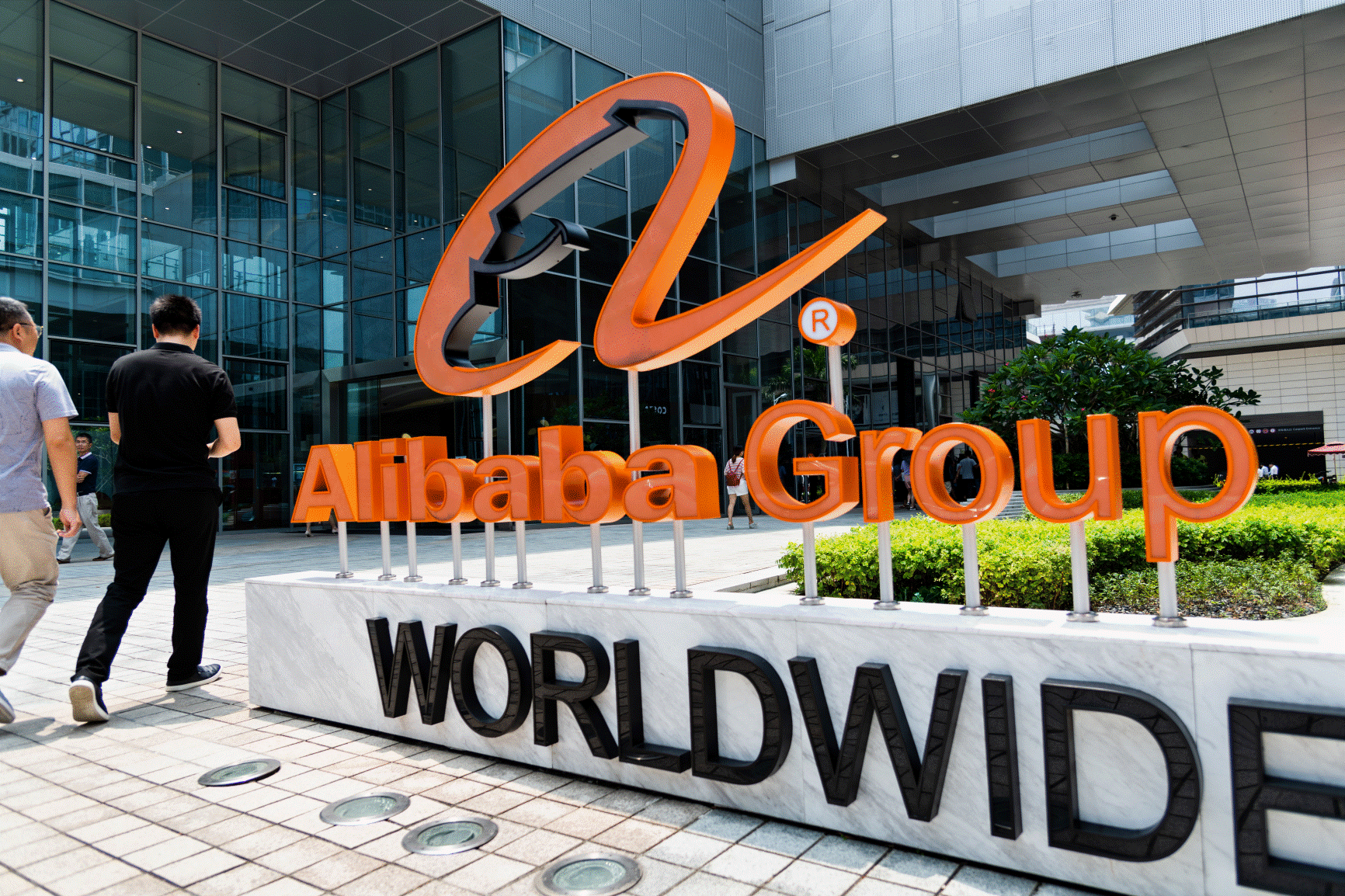
As the world enters an era of explosive growth in artificial intelligence (AI), processors have become the “fuel” that powers every breakthrough. However, amid U.S. export restrictions on advanced GPUs to China, leading Chinese tech giants are compelled to find their own paths forward. One of the most notable moves in recent months is Alibaba’s development of a new AI chip, which is expected to reshape the landscape of cloud computing and AI in China.
Alibaba is Developing a New AI Chip – What Has Been Revealed
According to CNBC and the Wall Street Journal, Alibaba has entered the internal testing phase for a next-generation AI chip. This processor is designed primarily for AI inference – the deployment phase of AI models that handles real-world data processing and responses – rather than training models from scratch. Unlike its previous Hanguang 800 chip, which was fabricated at TSMC, the new chip is being manufactured by a Chinese foundry, signaling a significant pivot in supply chain strategy. While no concrete specifications such as process node, memory bandwidth, computational throughput, or power consumption have been disclosed, the fact that the chip is already undergoing testing demonstrates Alibaba’s growing maturity in in-house chip design.
Why Alibaba Chooses “Inference First, Training Later”
In the AI lifecycle, training requires massive computational power, whereas inference is the phase directly tied to revenue, handling billions of user queries daily. For Alibaba, focusing on inference has three strategic implications. First, it allows cost optimization by lowering the total cost of ownership (TCO) for Alibaba Cloud, strengthening competitiveness. Second, it reduces dependence on Nvidia, as the supply of high-end GPUs remains unstable due to export controls. Third, it enables Alibaba to customize hardware for its own ecosystem, optimizing for workloads such as e-commerce, targeted advertising, search, financial services, and AI assistants.
The Competitive Landscape in China
Alibaba is not alone in this race. China’s domestic AI chip market has already seen strong players: Huawei’s Ascend series has gained traction in both training and inference, while Cambricon has posted impressive growth by riding the wave of substitution for imported chips. However, Alibaba has a unique advantage: the massive scale of Alibaba Cloud and its e-commerce ecosystem, which could exert significant competitive pressure on rivals. Furthermore, Alibaba’s entry may accelerate the development of domestic software standards, something China urgently needs to reduce reliance on international ecosystems.
Technical Unknowns and Challenges
Despite the hype, Alibaba’s new AI chip still raises several critical questions. What process technology will it use – can it reach advanced nodes like 7nm or below, or will it be limited to older fabrication technologies? Will its memory bandwidth and interconnect performance be sufficient to support large-scale inference workloads? Can Alibaba build a robust software ecosystem – including compilers, runtimes, and libraries – capable of supporting mainstream frameworks such as PyTorch and ONNX? And finally, what will the commercialization roadmap look like – will the chip be restricted to internal use within Alibaba Cloud or offered to external customers? The answers to these questions will ultimately determine the chip’s market impact.
Who Benefits – Who Faces Pressure?
If successfully commercialized, Alibaba Cloud customers will be the first to benefit by accessing more affordable AI services, less exposed to geopolitical supply disruptions. Nvidia, despite resuming sales of its H20 GPUs in China, could face erosion in inference market share if Alibaba’s domestic chip proves sufficiently reliable. Meanwhile, other Chinese AI chipmakers will confront tougher competition, though they may also benefit from a stronger domestic software ecosystem catalyzed by Alibaba’s market influence.
Alibaba’s development of a new AI chip is more than just a technological milestone; it is a strategic move within the intensifying U.S.–China tech rivalry. Although technical specifications and performance remain undisclosed, Alibaba’s focus on inference suggests a pragmatic approach: delivering a feasible near-term solution to reduce costs, reinforce Alibaba Cloud, and establish technological self-reliance. The critical question is whether this chip will be competitive enough to rival Nvidia’s offerings and whether Alibaba can expand its influence beyond its own ecosystem. The answer will shape not only Alibaba’s future but also the trajectory of AI in China for years to come.
(Source: CNBC)