 15
15Business
October 24, 2025
After 9 weeks of impressive gains, gold is entering a true “test of faith” for investors.

After nine weeks of strong gains, gold enters a “test of faith” for investors
After a fairly positive rebound on Thursday, gold turned slightly lower during the Asian trading session on Friday. With the current price action, the precious metal is heading toward its first weekly decline after nine consecutive weeks of gains, as investors take profits at record-high levels and await key U.S. inflation data to be released later today.
Market Focus: U.S. CPI Data
Investor attention is now almost entirely centered on the U.S. Consumer Price Index (CPI) for September — a data point considered the “key” to shaping the Federal Reserve’s next policy direction.
This CPI report was previously delayed due to the temporary U.S. government shutdown, which means its upcoming release could trigger a larger-than-usual “data shock.” If inflation shows a sharp decline, expectations for an earlier rate cut by the Fed will strengthen; conversely, a higher-than-expected CPI figure could push the U.S. dollar higher again, creating short-term downward pressure on gold.
Currently, markets are pricing in a 25-basis-point rate cut at the Fed’s meeting next week — an expectation that continues to serve as a psychological anchor supporting gold prices in the medium term.
Macro Factors: Low Rates Remain the Long-Term Foundation
In the long run, a low interest rate environment remains a solid foundation for gold, as the opportunity cost of holding a non-yielding asset becomes lower.
However, in the short term, profit-taking pressure, a stronger U.S. dollar, and investor caution ahead of the CPI release have put gold in a phase of consolidation. The market appears to be “catching its breath” after several weeks of sharp rallies.
Technical Analysis: Two Scenarios in Play
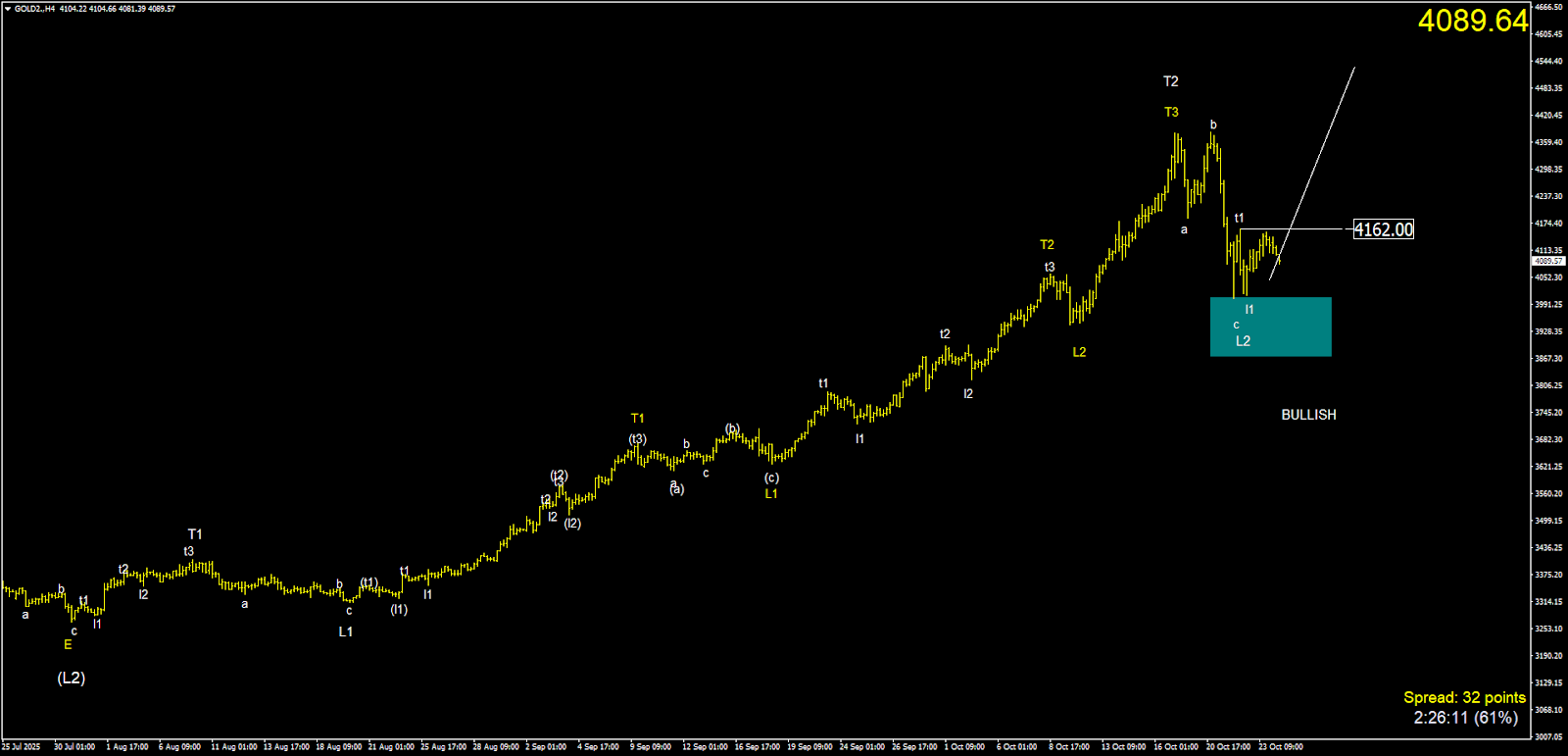
Although gold has rebounded more than $150, from $4,004/oz to $4,154/oz, this move alone is not yet sufficient to confirm a new bullish cycle — the $4,162/oz level remains the key confirmation threshold that needs to be broken.
The current wave structure suggests two possible technical scenarios:
Scenario 1 – Continuation of the uptrend:
Gold has completed the L2 white bottom at $4,004, and is extending its rise within a new upward wave cycle.
Wave t1 white completed at $4,162
Wave l1 white correction ended at $4,010
The current move is the rise toward t2 white
Confirmation condition: Gold must break above $4,162/oz to activate a medium-term bullish signal.
Scenario 2 – One more downward leg remains:
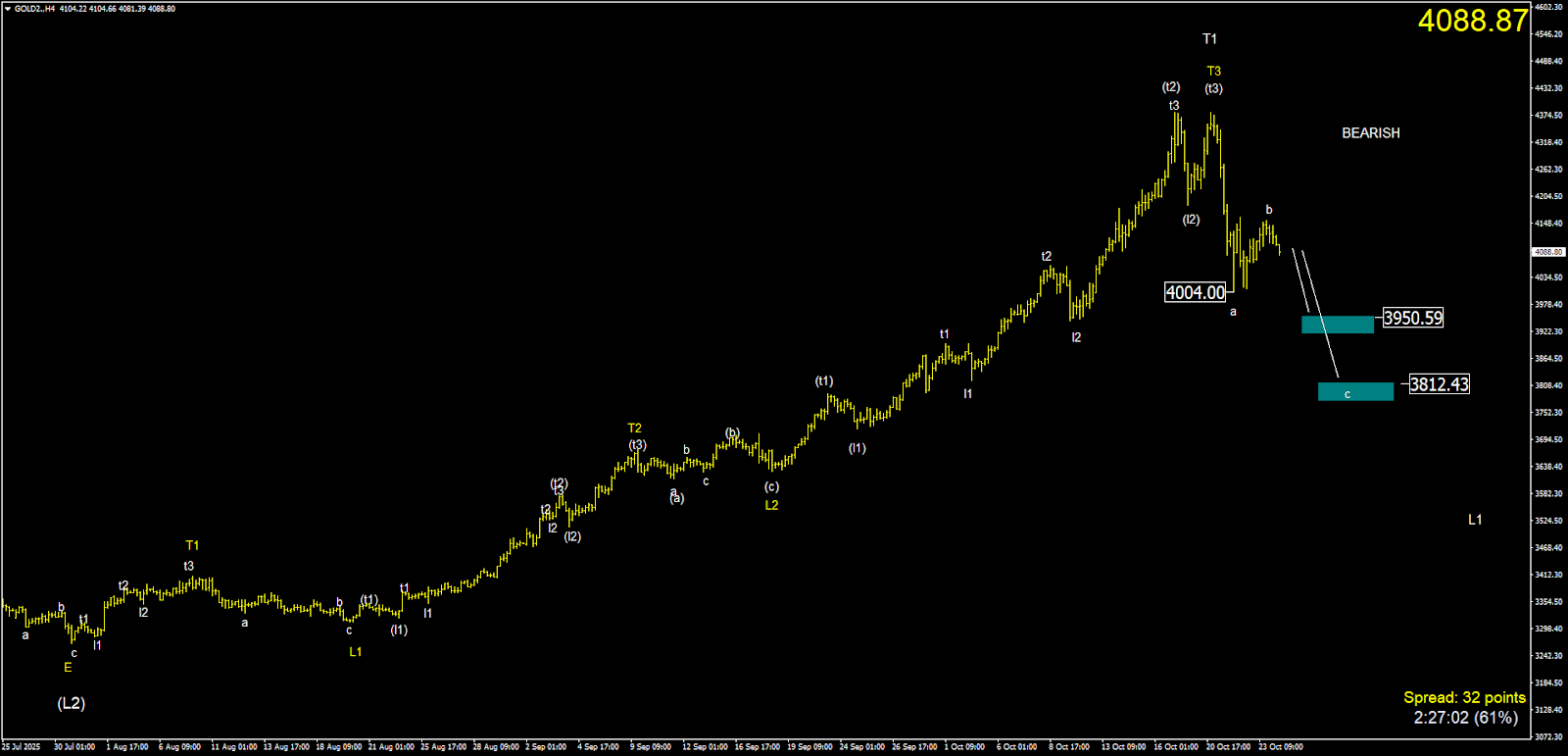
The $4,004 level may only represent point a (white) within an abc corrective structure, with point b already formed at $4,154. If this scenario plays out, gold is currently moving in the decline from b to c, and a decisive break below $4,004 would confirm a deeper corrective cycle — potentially extending toward the $3,930–$3,950 range, or even further down to $3,800–$3,820 per ounce.
From Data to Action: Choosing the Right Strategy
Although gold is showing signs of short-term weakness, the current decline appears to be more of a technical correction than a reversal of the long-term uptrend.
Technically: Gold is oscillating within the $4,000–$4,160 accumulation range, where the market is establishing a new supply-demand equilibrium.
In terms of sentiment: Investors are cautious ahead of the CPI data release, leading to low liquidity and narrow price movements.
Strategically: This is a time to observe and wait for confirmation, not a moment for emotional trading.
Long-term investors should remain patient and look for accumulation opportunities if prices hold the $4,010 support zone, or wait for a clear breakout above $4,162 to confirm upward momentum. Conversely, if gold breaks below $4,000, the market could enter a medium-term correction phase, requiring a reassessment of the overall trend.
In summary: After nine consecutive weeks of gains, a correction in gold is both natural and necessary. The current pullback could simply be a “breathing phase” within the long-term uptrend — a period of rebalancing before the market finds fresh momentum for the next cycle.
All gold, currency, and digital asset markets are continuously monitored and analyzed by Ebila AI to identify investment opportunities through a comprehensive, objective, and real-time perspective.
If you find Ebila AI’s analysis useful, share this post to help more investors gain a clearer and more informed view of the market.